Posts

Plural suffixing: (-s) or (-es)

Image
Understanding the 'essence' of the  plural suffixing pattern. During the past few years, teaching Grade One and Two students, I have often observed the children's puzzling expressions and seemingly random guesses when attempting to build a plural word from a singular word.  I have observed students who on one day will use (-s) to build a plural word in their writing but on another day decide to choose (-es), or use an apostrophe (-'s), for no real reason but just to experiment! Or maybe their parents have shared some 'interesting rule' that they learned at school many years ago.  The students can often  demonstrate understanding of the difference between singular and plural and know that there are two choices, (-s) or (-es) ... but which one?  Over the years,  I have implemented and experimented with a variety of different strategies and ways to support children's learning of this concept. Critical to success, is ensuring  the children hav...

Understanding how words are related through MEANING and SPELLING

Image
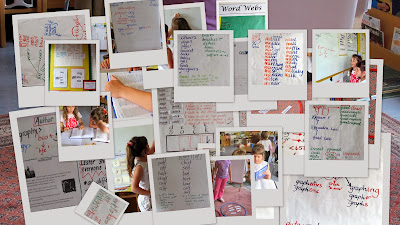
Building 'word webs' through a collaborative approach . Using a collaborative strategy, Round Table Word Webs ,  students will develop an understanding of the importance of  connecting  SPELLING  with  MEANING,  the essence of the English spelling system.  The students will have an opportunity to build a number of different word webs, by collecting words that all have a common  base . This activity will help students to understand how and why words are related in  'word families'  and how this essential knowledge demonstrates the key to the spelling. Read on for further details regarding this collaborative activity by clicking on the link.

Building Word Webs through a Collaborative Approach

Image
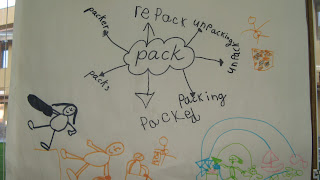
Orthography:  Morphology, Etymology , Phonology .  Searching beyond the word:  understanding how and why words  are related in  meaning and spelling. Round Table Word Webs is a collaborative activity that can support and guide young learners to fully understand the significance of identifying the meaning of the word to discover the spelling. This learning activity has been used with a variety of age groups and can be adapted to any level.  Please click on this link  to read more. Students build a word web for the base <pack>. Students creating a word web for the base <hope>. Students recording their theories and ideas for a 'work in progress' class word web for the base <light>. A published, but not completed, word web indicating the origin of the base <heal>.

Orthography in the Early Years: Investigating the underlying structure of English words to support essential reading, writing and spelling development

Image
Orthography in the early years ...Is that possible?  ...Is that  an essential part  of children's learning in the early years? ...Why would I teach such a concept to young children? Please refer to the blog post: Can you teach morphology to young children?